
In 1997, I decided to pick up a camera again. What followed changed me in ways I could not have ever imagined. The Power of the viewfinder.
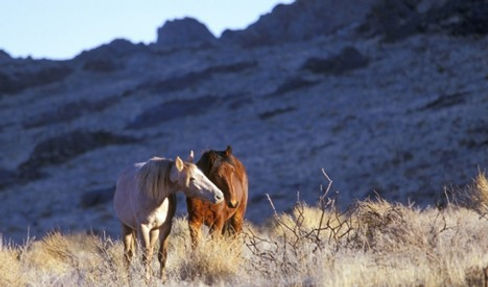
In January the following year, a friend introduced me to Utah’s west desert. As we traveled north along the east side of the Dugway range, I had my first encounter with a harem of wild horses. The significance of this day would not become clear to me for years.
I knew nothing about wild horses or the wild herds of the American West, and for that matter, had little knowledge of domesticated horses either. But seeing these creatures in the wild for the first time left me speechless.
The Wild Ones became mentors for me, teaching me the concept of patience. My evolving curiosity and desire to learn what these Beings were about took time; my first question was how do I earn their trust so I may integrate with them?
I was going through my own process of reinventing and rebuilding myself, exploring Buddhism and Eastern philosophy. Before taking one step towards them, I would say a blessing, letting them know I was not there to hurt them. I still perform this ritual today when photographing. animals or birds. Animals have a knowing.

In my early years of following the herds I patted myself on the back, thinking I was teaching them I was safe; it was quite the opposite. I finally realized they were silently telling me to slow down, enjoy what we are letting you see. When we are ready, we will come to you, and they did.
The best part of all of this, I knew they would not eat me, but maybe run over me. I have been charged twice. Taking the advice of knowledgeable horse folks, the only thing you can and must do—stand up, make yourself look as large as possible, raise your arms and challenge them. Seems pretty crazy to challenge a 900-pound animal running full tilt at you, but it works.
Of all my encounters with the Onaqui and Cedar Mountain horses, the most memorable was the opportunity to follow a days-old filly, photographing her first year and a half of life. Each time our paths crossed, I gained insight into the relationship between mare and foal, and their lives within the harem and herd. July and early August were hit and miss due to the Onaqui Herd splitting into two groups. By the middle of August, the filly and I had reconnected. I sensed a closeness between us, which was validated in the following months, culminating in October when she cemented our bond by placing her head trustingly over my lens.
Through this journey with the Onaqui and Cedar Mountain horses, they shared their wisdom, allowing me to grow. Animals will teach us if we choose to listen. After twenty years of following my four-footed family, I recently published my first book, MUSTANGS, Utah's Onaqui and Cedar Mountain Herds.
My only request: please become informed and lend your voice to save these magnificent Beings and the land on which they reside.
Returning to Vietnam
2006 brought an opportunity to break through some very old, hardened crust—it was not pleasant, but needed. With two tours in Vietnam from April 1968 through April 1970, I never realized just how broken I was regarding certain issues. At the time, I did not think there was anything that needed to be addressed.
Returning from Nebraska after photographing the spring migration of sandhill cranes, I needed to refill my fridge. I was zooming through Wild Oats when fate presented a gift. I met someone who turned me inside out. As our dating dance progressed, my shortcomings rapidly appeared. With caring and encouragement, she became the catalyst for me to start looking inward, asking questions, eventually planting the idea of sitting with a therapist, the best gift I have ever received.
My therapist’s counseling partner shared a poem by Jungian philosopher Sam Keen entitled, "The Enemy Maker: How to Make an Enemy." I knew instantly what I needed to do: return to Vietnam. I always had questions about what I did and why my country was involved. The evening of July 5, 2007, seven months after listening to Mr. Keen’s words, I walked up the jetway on a hot, steamy Saigon evening, bringing emotions of the past front and center.
On the 20-minute ride from Tan Son Nhut airport to Saigon’s District 1, it became clear to me why I was there. All of us who served during the war could not look at Vietnamese people without being extremely cautious due to the intermingling of friend and foe, clouding our ability to view any of them favorably.
Like a child anticipating Christmas morning, I was on the street at six a.m., less than seven hours after landing. The morning commute was well underway, with three, sometimes four, on a motorbike heading to wherever, carts with produce or goods being pushed and pulled, people carrying wreaths of flowers for funerals: Saigon was alive.
Taking in what was in front of me, my own internal video was playing. I had only been through Saigon a few times in the late ’60s, but now after 37 years, I was still reactive, looking everywhere for danger. With time, I slowly began to let my guard down; however, at first it was an uncomfortable effort. The process of healing began.


I have returned five times, with one more trip to do. Traveling from the border of China to the Gulf of Thailand, interviewing survivors from the My Lai massacre, and attending the 40th & 50th memorial ceremonies. Sitting with my former enemy, drinking home-made rice wine (you can fuel jets with it) until we giggled like kids. We were both happy to see the good in one another. I believe there was closure for both of us.
To categorize my return as a breakthrough moment would be a gross understatement; it was life-saving in so many ways. If someone had told me in 1970 that I would have friends from Hanoi, I would have had a healthy laugh, but I do. I have been to their home in a hamlet being swallowed by Hanoi’s rapid growth, and told I was the first Euro (slang from when the French ruled) ever in their hamlet; it was humbling. Having dinner, meeting Phong’s father (Trang’s husband), who was in the North Vietnamese Army outside of Saigon the day it fell. To this day, Trang & Phong and I still communicate. It has been a healing process, one that is not yet complete.
My camera opened my heart, starting a journey that I could have never imagined.
The Enemy Maker: How to Create an Enemy
Sam Keen
Start with an empty canvas.
Sketch in broad outline the forms of
men, women, and children.
Dip into the unconscious well of your own
disowned darkness
with a wide brush and
stain the strangers with the sinister hue
of the shadows.
Trace onto the face of the enemy the greed,
hatred, carelessness you dare not claim as
your own.
Obscure the sweet individuality of each face.
Erase all hints of the myriad loves, hopes,
fears that play through the kaleidoscope of
every infinite heart.
Twist the smile until it forms the downward
arc of cruelty.
Strip flesh from the bone until only the
abstract skeleton of death remains.
Exaggerate each feature until man is
metamorphosed into beast, vermin, insect.
Fill in the background with malignant
figures from ancient nightmares – devils,
demons, myrmidons of evil.
When your icon of the enemy is complete
you will be able to kill without guilt,
slaughter without shame.
The thing you destroy will have become
merely an enemy of God, an impediment
to the sacred dialectic of history.