
THE OLD MAN AND THE FENCES
Alex Barr
To a man of eighty, a thousand-foot hill is Everest. I see it from my kitchen window, three miles away, featureless green sloping to an inscrutable summit, often attended like Bali Ha’i by low-flying cloud. Its name is Cilciffeth—no-one here in Wales knows what that means. I knew I had to face the trial of strength it offered. From a challenge ever before your eyes, there’s no escape.
In my youth I ascended the highest peaks of England, Scotland, and Wales. It was hard to let go that version of myself. I thought I could take in a long road walk before the start of the bridleway up Cilciffeth. How often I’ve rushed into things without investigating the pitfalls. The road swung left invitingly and I ignored the smaller road straight on. I was soon lost. The map made no sense. At an isolated property, a not-too-friendly woman gave me confusing directions. A half mile on, exhausted, I aborted my mission.
For my second attempt I parked much nearer. No wrong turning this time. I reached the B4313 road, and found the bridleway. I thought a bridleway was a path you can ride a horse on, but I wouldn’t have ridden on that one, more stream than path, dangerously uneven, hemmed in by overgrown hedges. I was attacked by horse botflies which left furuncular lesions and a swollen finger. I sat on a grassy mound and drank water.
Further on, the path widened and a view of distant hills, patches of woodland, and scattered farmsteads opened up. I made my second stop, this time with coffee. My home-made lemon polenta cupcake was tempting, but I saved it. The day had warmed and I was glad I brought shorts to change into.
Cilciffeth was now ahead on the right. The map showed its eastern flank outlined in brown, denoting ‘Access Land’ where you could walk at will. But access was denied by a steep bank topped by a barbed-wire fence. I thought of turning back, less through fatigue than a hopeless feeling, but the rhythm of my feet led me on until I saw an opening, amateurishly blocked with rusty pieces of gate. I climbed over. I was on Access Land.
Without an obvious path to the summit, I had to trek through low gorse and grassy tussocks which threatened to turn my ankle. The thought of having to be recovered by air ambulance or mountain rescue unnerved me, and there was no cell phone signal. Go on, or turn back? The map showed the summit just half a mile away, but I had lost the ability to judge the effort needed to cross that irritating terrain. I went on, but halted every twenty yards or so to reconsider. Would ageing legs hold out? Imagining the shame of a second failure drove me on.
Cilciffeth is one of those hills where the skyline keeps suggesting a summit, then offers more rising ground as you approach. The only landmark ahead was a group of scrubby trees. I headed for them. They seemed to get no nearer. I thought of my friend M, with whom I enjoyed many walks, and whose death left me diminished. What would he say? “Press on!” I pressed on.
Then I saw the fence. I had noticed it on the map and feared it would block me, but was surprised to see a gate in it. Nevertheless I was very tired. I took off my backpack and flopped down. Could I retreat without dishonor? Had I earned more coffee and—at last—the cupcake?
Magic! The sweet sticky substance revived me. I climbed the locked gate. An overgrown cart track led on. A slight rise to my right was the summit itself, but that was a distraction, because my main aim was to see the harbor town I lived in, and if possible, my house, reversing the view from the kitchen. I plodded on until I saw the long pale row of houses on the headland above the harbor, then the harbor itself. It was enough.
I retraced my steps, not suspecting what lay ahead. The problem with a mountain is that if you lose the end of the path you reached the summit by, you may descend by a different path which takes you miles from your starting point. Walking down through what seemed the same gorse bushes and patches of burnt heather, I saw a gate. It wasn’t the opening where I had climbed over, but surely led onto the right bridleway further along?
It seemed not. Not far along the path petered out. Now I had to climb locked gates, field after field, reached through waterlogged mud churned up by cattle. Between waves of panic, I felt surprising moments of calm. The result of years of meditation? Or the feeling that in old age nothing matters?
My strength still hadn’t given out. But where was the B4313? The landscape of small hills and patches of woodland was no different from that near my starting point, except in the details. After several more gates I saw a respectable-looking road in the distance. It curved round a hill, gently rising—and completely unfamiliar.
There were no more gates. Now I had to climb hedgebanks topped with barbed wire fences. Then—a sign my hiking days were over?—the sole of my right boot came off. And yet I still felt calm. These obstacles were taking all my concentration.
At last I reached a road. I’ve often arrived at well-known places from an unfamiliar angle, making them strange. To my surprise, a sign read B4314! It was the same road that went on to curve around a hill. I noted surrounding landmarks and checked the map. I had reached the B4314 a mile-and-a-half from where the bridleway joined it.
A Hopalong Cassidy route march lay ahead. Surprisingly, I enjoyed it. At the limit of my strength, I reached the car.
I had conquered Cilciffeth.
"The Old Man and the Fences" was published in 2024 in New Isles Press Issue 3, “Border Teorainn Mairch” in Northern Ireland. The story tells of a physical challenge and ordeal overcome by a man of eighty, spurred on by a memory of what his oldest friend would say.
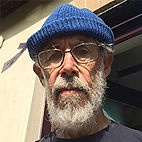
ALEX BARR's publications include two short fiction collections and three poetry collections, the most recent of which is Light and Dark (Kelsay Books, 2024). He is assembling a collection of nonfiction. alexbarr.co.uk